
A Fourier series represents a periodic waveform as a combination of a DC component, a fundamental component, and higher harmonics.
Before starting with the Fourier series, it is important to understand a few basic properties of periodic waveforms. In power electronics, many important voltage and current waveforms are periodic. Examples include the switching-node voltage of a DC-DC converter, inverter output voltage, and rectifier currents.
Periodic Function
A function \(f(t)\) is said to be periodic with period \(P>0\) if
for all \(t\) in its domain.
In simple terms, the function repeats itself after every interval of length \(P\).
If there exists a smallest positive value of \(P\) for which
Then this value is called the fundamental period or least period of the function.
Example
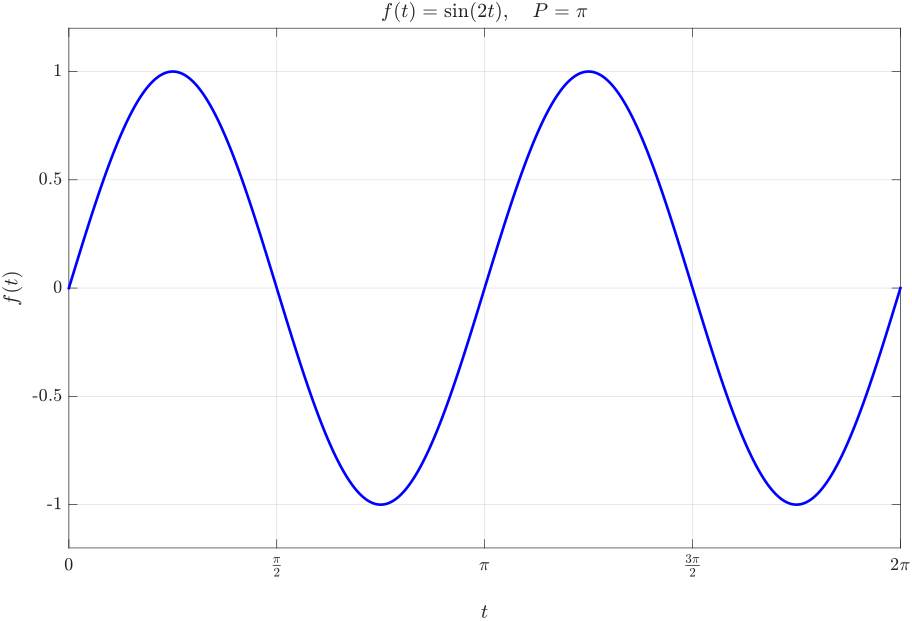
Consider the function \(f(t)=\sin(2t)\) shown in Figure 1.
We know that a sine function repeats whenever its argument changes by \(2\pi\). Therefore,
For the function to repeat, its argument must increase by \(2\pi\). Hence,
Therefore,
We can verify this directly:
Therefore, the fundamental period of \(\sin(2t)\) is
Period, Frequency, and Angular Frequency
For a time-periodic waveform, the period is commonly represented by \(T\) in electrical engineering. The symbols \(P\) and \(T\) therefore represent the same quantity: the time required for one complete cycle.
The frequency \(f\) tells us how many complete cycles occur per second. It is the reciprocal of the period:
The unit of frequency is hertz \(\mathrm{Hz}\).
The angular frequency \(\omega\) describes the rate at which the phase changes. Since one complete cycle corresponds to \(2\pi\) radians,
Using \(f=1/T\),
Therefore, the fundamental relationships are
or equivalently,
| Quantity | Symbol | Meaning | Unit |
|---|---|---|---|
| Period | \(T\) or \(P\) | Time required for one complete cycle | s |
| Frequency | \(f\) | Number of complete cycles per second | Hz |
| Angular frequency | \(\omega\) | Angular change per second | rad/s |
For the previous example, \(f(t)=\sin(2t)\). Comparing it with the general sinusoidal form \(f(t)=\sin(\omega t)\) gives
Therefore,
and
Thus,
These concepts provide the foundation for Fourier-series analysis. Once the period and fundamental frequency of a periodic waveform are known, we can describe the waveform in terms of its DC component, fundamental component, and harmonic components.
Fourier Series
Consider a periodic function \(f(t)\) with fundamental period \(T\) (the smallest positive period for which the function repeats):
The corresponding fundamental frequency \(f_0\) (the frequency associated with one complete repetition of the waveform) and fundamental angular frequency \(\omega_0\) are
A periodic function with fundamental angular frequency \(\omega_0\) can be represented as a sum of a constant term and sine and cosine functions whose frequencies are integer multiples of \(\omega_0\). This representation is called the Fourier series of the function.
The Fourier series can first be written in its expanded form as
Here, the sine and cosine functions are the basic periodic building blocks of the more general periodic function \(f(t)\).
The first term \(a_0/2\) is the DC component (the average value of the waveform). The terms containing \(\omega_0\) form the fundamental component, while the terms containing \(2\omega_0,3\omega_0,\ldots\) are called the higher harmonics (sinusoidal components whose frequencies are integer multiples of the fundamental frequency).
Using the harmonic number \(n=1,2,3,\ldots\), the expanded Fourier series can be written compactly as
where \(a_0,a_n\), and \(b_n\) are called the Fourier coefficients (constants that determine the contribution of the DC, cosine, and sine components to the waveform).
The Fourier coefficients are obtained over any one complete period of \(f(t)\):
Here, \(t_0\) is an arbitrary starting point, and the interval from \(t_0\) to \(t_0+T\) represents one complete period.
The role of the harmonic number \(n\) can be seen directly by expanding the series:
| Value of \(n\) | Component | Angular frequency | Frequency |
|---|---|---|---|
| \(n=0\) | DC component | \(0\) | \(0\) |
| \(n=1\) | Fundamental | \(\omega_0\) | \(f_0\) |
| \(n=2\) | Second harmonic | \(2\omega_0\) | \(2f_0\) |
| \(n=3\) | Third harmonic | \(3\omega_0\) | \(3f_0\) |
| \(n\) | \(n\)th harmonic | \(n\omega_0\) | \(nf_0\) |
Thus, a periodic waveform is represented by a DC component together with sinusoidal components at
or equivalently,
This idea is particularly useful in power electronics, where voltage and current waveforms are often periodic but non-sinusoidal. Fourier series allows such a waveform to be expressed in terms of its average value, fundamental component, and harmonic components, providing the basis for the analysis of switching waveforms, ripple, filters, and harmonic content.
Magnitude-Phase Form of the Fourier Series
The trigonometric Fourier series expresses each harmonic using separate cosine and sine components. While this form is convenient for deriving the Fourier coefficients, it is often more useful in engineering to describe each harmonic by a single magnitude and phase angle.
The magnitude-phase form combines the cosine and sine terms at the same harmonic frequency into one equivalent sinusoidal component. This makes it easier to see how strongly each harmonic is present in the waveform and what phase shift it has relative to the chosen time reference.
For the \(n\)th harmonic, the magnitude \(C_n\) represents the peak amplitude of that sinusoidal component, while its RMS value is \(C_n/\sqrt{2}\).
The trigonometric Fourier series is written as \(\text{equation }(1)\)
For each harmonic, the sine and cosine terms at the same frequency \(n\omega_0\) can be combined into a single sinusoidal term.
Thus,
can be written as
where \(C_n\) is the magnitude of the \(n\)th harmonic and \(\phi_n\) is its phase angle.
Therefore, the Fourier series can be written in magnitude-phase form as
The harmonic magnitude is
and the phase angle is
The use of \(\operatorname{atan2}(b_n,a_n)\) is preferred because it gives the correct phase quadrant from the signs of both Fourier coefficients.
The expanded form is therefore
Here, \(C_1\) is the magnitude of the fundamental component, \(C_2\) is the magnitude of the second harmonic, \(C_3\) is the magnitude of the third harmonic, and so on.
Thus, the two Fourier-series forms contain the same information: \(a_n ,b_n\) describe the cosine and sine contributions separately, while \(C_n ,\phi_n\) describe the same harmonic using its magnitude and phase.
This Fourier expansion is especially useful for analyzing periodic voltage and current waveforms in power electronics.
Estimated reading time: 7 minutes